Case 03 — Independent Research
Quantifying Narrative Structure in DJ Sets
Independent research testing whether “narrative” DJ sets are structurally different from regular sets — not just a matter of taste, but a measurable difference in how energy, texture, and harmony move through time. Applied nonlinear dynamics and recurrence analysis to 19 DJ sets to find out.
My Role
Sole researcher
Team
Independent project.
Timeline
4 weeks, as a proof of concept (work in progress)
Methods
Detrended Fluctuation Analysis (Hurst exponent), SVD arc classification, Recurrence Quantification Analysis (RQA), Mann-Whitney U testing, qualitative listening analysis.
01 — The Challenge
The Challenge
DJs and dance floors recognize the difference between a set that “tells a story” and one that's just well-mixed. But that judgment has always lived entirely in the ear.
No one had asked whether narrative sets are structurally different in a way you could actually measure — or whether “narrative” is just a vibe people project onto sets they like. Three questions drove the research:
- Do storytelling DJs actually play differently, or does it just feel that way? Is there a measurable structural difference between sets perceived as narrative and sets that are mixed?
- Does a great set “remember” where it's been?
Do narrative sets show long-range memory in their energy and brightness — a real trend over time, not just random fluctuation? - Does a narrative set follow one big shape, like a mountain or a wave?
Can a set's overall energy trajectory be classified into a recognizable arc — and does that arc shape separate narrative sets from regular ones? - Do narrative DJs deliberately call back to earlier moments?
Do narrative sets revisit earlier textures and energy states in a structured way, rather than moving forward without looking back?
Assumptions
Two things this study assumes. First, which sets counted as “narrative” versus “regular” was my own call as a DJ and house music lover — the whole analysis rests on that label being a fair proxy for what a narrative storytelling set actually means. Second, energy, brightness, and harmonic tension were chosen as the variables to test based on my own reasoning about what should carry narrative structure; other features like rhythm, percussive density, and transition technique weren't tested and might show something different.
02 — My Approach
My Approach
“Narrative” is a vague judgment. I broke it into three separate pieces — memory, shape, and callbacks — and gave each one its own method, borrowed from a different field: physics, computational narratology, and complex systems dynamics.
STEP 01
Build a reusable pipeline
I wrote a Python pipeline that downloads each set and extracts three audio curves — energy, brightness, harmonic tension — into one shared table built for cross-set comparison. Every later analysis reads from this same source, so adding a new method never meant redoing the extraction.
STEP 02
Layer three methods, each triggered by the last result
Hurst exponent tested memory first — the simplest, most defensible starting point. When arc-shape classification came back flat, that negative result pointed the next step: if structure wasn't in the global shape, it might be local and repeated. That's what led to recurrence analysis.
STEP 03
Stress-test every result before trusting it
Before accepting any finding, I checked whether it survived scrutiny: excluding sets with poor data quality, controlling for loudness as a confound, and using Mann-Whitney U test to see if group A or B gaps are meaningful. A result only counted once it held up under these checks.
03 — The Work
The Work
The work moved from a single hunch — that narrative DJs feel like they tell a story — through three increasingly specific tests, each one confirming, correcting, or redirecting the last.
Memory: does the past predict the future?
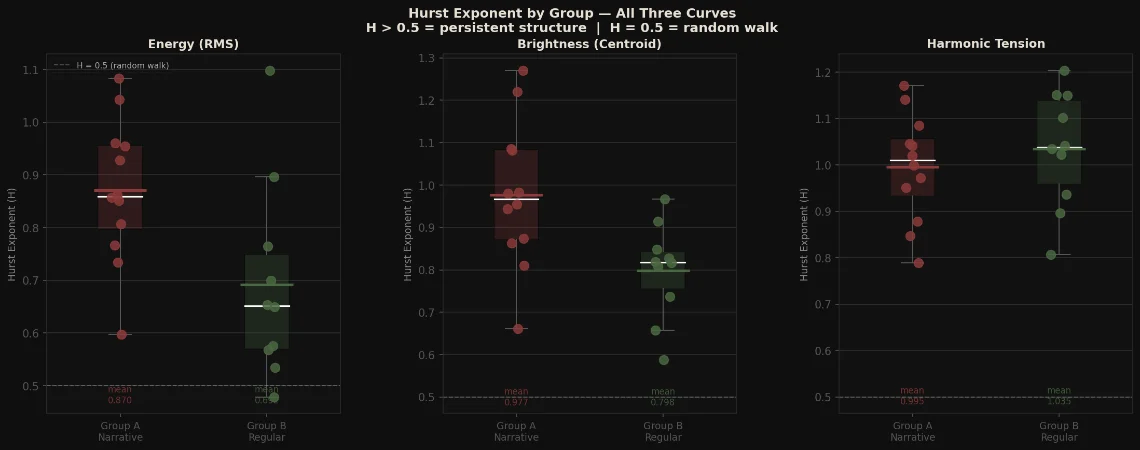
All DJ sets have some deliberate structure, they are not random. I measured long-range memory (Hurst exponent) on energy, brightness, and harmonic tension for every set. Energy and brightness both separated narrative from regular sets in the predicted direction. I stress-tested this two ways: excluding sets with poor data quality (the effect held), and controlling for loudness (ruling out “narrative sets are just louder”).
Shape: does the set trace a recognizable story arc?
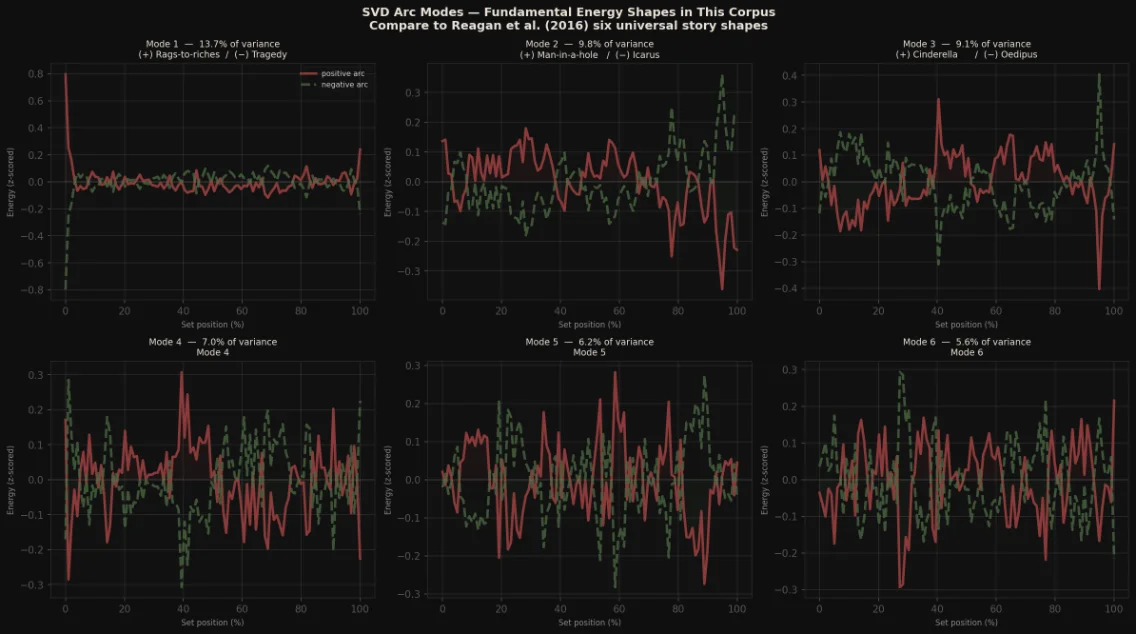
DJ sets follow different “story” arcs than narrative literature. Using a shape taxonomy borrowed from Reagan et al.'s six-shape taxonomy in novel-structure research, I classified each set's overall energy trajectory. The result was a clean negative — narrative and regular sets landed in the same shape categories with no real separation. Rather than force a signal by adding more sets, I treated this as a real finding: narrative structure doesn't live in one dominant overall shape.
Callbacks: does the set return to earlier ground?
Narrative DJ sets stay in a certain vibe for longer, or a “chapter”. The flat story arc shape result motivated this step directly. I built a recurrence analysis pipeline and this produced the strongest result in the whole study: narrative sets showed significantly more recurrence, more deterministic repeats, and — most notably — much more dwelling in a state before moving on. This matched my own listening-based observation that narrative DJs move through distinct, extended genre chapters.
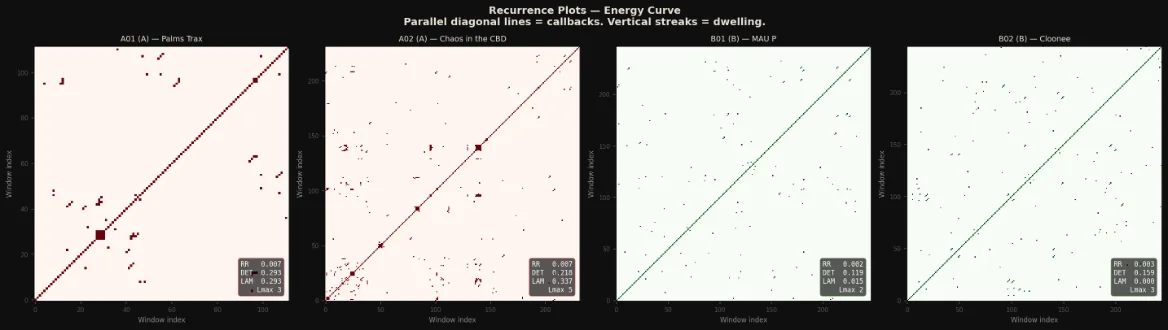
Recurrence plots comparing a narrative set (dense, block-structured) against a regular set (sparse, scattered) — the visual signature behind the dwelling finding. Blocks and long parallel lines show callbacks and dwellings in energy.
04 — Outcome & Impact
Outcome & Impact
Narrative sets are measurably different.
Across seven independent metrics (Hurst plus RQA's recurrence, determinism, and dwelling), narrative sets scored significantly higher than regular sets, with large effect sizes that survived controlling for loudness.
The story isn't in the overall shape — it's in the chapter.
Arc shape didn't separate the groups at all. What actually distinguished narrative sets was local behavior: they linger in a state or "chapter" longer before moving on, and they circle to earlier textures more deliberately than regular sets do. The "story" lives in the pacing, not a single overarching build.
Narrative sets play in chapters.
The high-laminarity in RQA or the dwelling finding lines up with the observation that narrative sets pass through multiple genre "chapters," while regular sets stay within one subgenre's textural envelope.
A different way of studying DJ sets.
Combining these three methods on DJ set structure is still experimental — borrowing from physics, narratology, and complex systems research to study a domain usually analyzed by ear alone.
05 — What I Learned
What I Learned
Quantifying a “vibe” doesn't mean removing the human — it means using your ear as the check on the math. When RQA flagged extended dwelling in the narrative sets, I went back and listened at those exact timestamps to confirm the vibe actually held. The numbers only mattered if they matched what I could hear.
Sometimes you have to change your research questions and lean into your gut feeling. When arc shape came back flat, I went back to my instincts as a DJ and asked what I actually knew that I hadn't tested yet. That's what led to dwelling and recurrence as the real signal.